(Topic: Words, Death, Reactions, Triggers)
Hi Friends,
A few weeks ago, I posted about 15 words related to death that I either liked or disliked, and shared my reasons why I find some to be better than others.
I don't often have a lot of people comment on my posts, here or on Facebook or instagram (where I share the links) but I often do have a few people reach out and chat with me about what I wrote. I love those conversations! Sometimes I learn a lot, too.
After that post about words, though, several people reached out to me, and not all of them were the people who most frequently reply! I wanted to address a couple of the concerns and points that were brought to my attention.
One of the concerns people had was that they had used a word that I found problematic. First of all, if you're doing your best, I'm not likely to be offended even if I disagree with your word choices. Second, if I find the word choice problematic, I will almost certainly let you know! I know that most people are well intentioned, and don't realize the deeper ramifications of their word selections. So I will likely explain and help you understand my reasons, but I will not be offended. Generally, I write posts like that to help people see my perspective, to give them some context for when they next have to choose words; I don't generally write because I have been super offended (opinionated, yes; offended, not usually!).
One of the other comments I got was that I'd missed some important words.
I limited myself to 15 because it made a good post length - there are so many words I could have included!!! I tried to hit the top several I personally consider to be either really bad or really good. But they were based solely on my own experience - several examples were given to me based on other peoples' experiences. They are just as valid as my own experiences, but simply didn't make my list because I haven't encountered them as much. If there are specific words or topics you would be interested in seeing me address, please feel free to reach out! If I have enough words to make another post (with enough context that I feel comfortable writing about them), I might make another list.
Thank you for reaching out and talking to me about what I wrote! I always hope that what I write is helpful or makes people think, and it's nice to hear people's reactions.
Yours,
Sarah
To subscribe, find the "subscribe by email" note in the left column and enter your email there. Links to posts will be emailed directly to you whenever I post them! Nothing else gets emailed.
Resource list: Visit my spreadsheet at www.tinyurl.com/infantloss
Showing posts with label death. Show all posts
Showing posts with label death. Show all posts
Wednesday, December 18, 2019
Wednesday, November 20, 2019
15 Words About Death and Infant Loss
(Topic: Words about death, opinions about effects of words)
One of the things I notice as the mom of a baby who died is that people sure use a lot of words about death that aren't dead! Some of these words are fine, but some are possibly problematic for some people. Many of the words below are fairly generic, and a few are infant loss specific. The opinions are my own, but also based on what I have heard others say within the infant loss community.
Side note: baby vs fetus, and other thoughts about asking personal questions in public
Occasionally you will hear loss parents complain when a medical professional - or worse yet, someone in everyday life who may be retired from medical life - call a baby who died during a pregnancy "a fetus". Here's why we complain: while they are technically right (embryo and fetus are technically two phases of development of the baby in utero), the fact is that to the parents that is their baby, with all of the associated love and feelings. To have someone use a technical term that feels like it negates the love and hope, that's extremely hurtful. There are doctors who realize this, and when talking with parents will only call it a baby, but some don't realize. I've had this happen to me (with a retired labor and delivery nurse, who had not realized the pain and dissociation she was causing). I tried to explain it to her, several times, and ended up leaving a group when I realized she was not going to even try to change her terminology despite knowing that it was hurtful to someone right in front of her.
Please try to listen and observe loss parents you come in contact with. While some of what they request might be personal preference, most of what they say will be helpful for you to consider applying broadly to any loss parent, or even more broadly in life in general. For instance, asking if someone has kids or how many kids they have is almost always a more complicated question than it sounds like (did they have fertility issues? Pregnancy or infant loss? What about custody issues or legal issues with their children being taken away?). I suggest not asking, or asking very obliquely if you have to ask. Many parents will volunteer the info they want you to know, and the rest is (respectfully) none of your business.
Thank you for listening to my suggestions, as a fairly outspoken loss mom, on the topic of words concerning death. I hope that my thoughts are helpful to you, and that you take a moment to chose the word you really mean, the next time you speak of someone who died.
Lots of love,
Yours,
Sarah
To subscribe, find the "subscribe by email" note in the left column and enter your email there. Links to posts will be emailed directly to you whenever I post them! Nothing else gets emailed.
Resource list: Visit my spreadsheet at www.tinyurl.com/infantloss
Hi Friends,
One of the things I notice as the mom of a baby who died is that people sure use a lot of words about death that aren't dead! Some of these words are fine, but some are possibly problematic for some people. Many of the words below are fairly generic, and a few are infant loss specific. The opinions are my own, but also based on what I have heard others say within the infant loss community.
1. Angel
This is a term commonly applied to a baby who dies. Some people love it and are comforted by the image of their child with wings. However, this is not a term I particularly like, although I use it often within the infant loss community because it's so common that it's easily understood. I try not to use the term to others, though, because there are several issues with the term. The first is that biblically, angels are a completely different being than humans, and have nothing to do with what happens when humans die. The second is that this is a Christian term, so it's alienating to any parent who is not Christian or not religious, and could make them feel left out, or guilty for not having that vision of their child.
Confusingly, outside the infant loss community, "angel" is often used to refer to children who behave well. This has actually led to several awkward situations for me personally - I have a shirt that says "mommy of an angel" but has a really obvious awareness ribbon (it should have been clear that I didn't just mean "well behaved"), but several people misinterpreted the shirt, and seemed uncomfortable when I pointed the awareness ribbon out and clarified.
Confusingly, outside the infant loss community, "angel" is often used to refer to children who behave well. This has actually led to several awkward situations for me personally - I have a shirt that says "mommy of an angel" but has a really obvious awareness ribbon (it should have been clear that I didn't just mean "well behaved"), but several people misinterpreted the shirt, and seemed uncomfortable when I pointed the awareness ribbon out and clarified.
2. In Heaven (in a better place)
Just like the term "angel," saying that someone's loved one is in heaven, if the parent didn't say it first, is assuming the parent's religious affiliation, and could alienate them if you guess wrong by using your own views. If the parent says it first, then they've informed you of their views, and it's probably safe to use. However, don't assume that heaven is a "better place." To me, and to many loss moms I've spoken to, the best place for a baby is in their parent's arms. Heaven somehow feels second best, and someone else telling me that it's better that he's there than here just feels like a slap in the face.
3. Dead
Honestly, I like the term dead. I mean, I don't love that my son is dead, but I love that when I say that, there is no ambiguity. No child will misunderstand me, and it's not a pat on the head like some terms for what happened. Watch the loss parent for clues, though: use the word they use, because it will most likely be the term they are most comfortable with. For me, the honesty and clarity of this term are important, but not all parents will feel the same way I do.
People also use "I'm dead" or "I died" figuratively when something is particularly funny or embarrassing, but this is not usually ambiguous because they are literally standing in front of you and clearly breathing.
People also use "I'm dead" or "I died" figuratively when something is particularly funny or embarrassing, but this is not usually ambiguous because they are literally standing in front of you and clearly breathing.
4. Death
The same as "dead" - this term is unambiguous and direct, so I like it! For instance, I will say "since Charlie's death" rather than "since Charlie's stillbirth" or "since Charlie passed" because it's very clear what happened and doesn't mask it.
5. Died
I'm going to start repeating myself here! Yup, it's simple, effective communication. "Died" is exactly what happened. In our case, Charlie died before birth, but in the second half of the pregnancy, which means that when I gave birth to him, it was a "stillbirth." But regardless of the situation, he died, which also means that before that, he lived. Simple, unambiguous.
(Note that same as above with "dead", some people do use this figuratively when they feel embarrassed or found something particularly funny - but they are usually obviously still in front of you and alive, so it's clear that they are using it figuratively.)
(Also note that in some religions, societies, laws, and cultures, life is defined differently. Some view life as beginning with sperm (and maybe egg), others as beginning with conception, others as beginning when the baby starts to move (or "quicken") in the womb, and others when the baby breathes for the first time outside the womb. I personally believe that 1) it's complicated, and 2) conception is scientifically an important part, and 3) this doesn't mean that the baby's life is more important than the mother's. That's as far as I want to go into that issue here, but from the perspective of loss parents, the "official" time of beginning of life is less important than the beginning of their hopes and dreams for the baby, which usually begin right around when a couple find out they are expecting a baby. For them, that baby is a living baby from that moment on, at least in some ways.)
(Note that same as above with "dead", some people do use this figuratively when they feel embarrassed or found something particularly funny - but they are usually obviously still in front of you and alive, so it's clear that they are using it figuratively.)
(Also note that in some religions, societies, laws, and cultures, life is defined differently. Some view life as beginning with sperm (and maybe egg), others as beginning with conception, others as beginning when the baby starts to move (or "quicken") in the womb, and others when the baby breathes for the first time outside the womb. I personally believe that 1) it's complicated, and 2) conception is scientifically an important part, and 3) this doesn't mean that the baby's life is more important than the mother's. That's as far as I want to go into that issue here, but from the perspective of loss parents, the "official" time of beginning of life is less important than the beginning of their hopes and dreams for the baby, which usually begin right around when a couple find out they are expecting a baby. For them, that baby is a living baby from that moment on, at least in some ways.)
6. Deceased
Actually, this is my favorite option. You know why? It's just as clear as dead/death/died, because it has no other meanings at all. But our culture often cringes at the stark reality of dead/death/died, and deceased has a higher register (i.e. usually used in more formal circumstances), so it gives us the feel that we have put a bit of distance between us and the gross tragic reality. When I talk to strangers and Charlie comes up, usually because they ask how many kids I have, I often say "I have one son, he's deceased." The stranger is immediately informed of his death with no ambiguity or beating around the bush, but they are not as shocked as they would be with the immediacy of the word dead.
7. Passed away
If you think about it, "passed away" doesn't really have too many other interpretations even if you try hard, but because it's not as direct, it's still difficult to understand if you're a child or if your first language isn't English. If you are new to English in any way, it is easy to accidentally parse this as "passed" + "away", which sounds like "passed by" or other versions of people walking past you. So this can be misunderstood in some scenarios. "Passed away" is a collocation or phrase that only has one meaning when the words are together, but the words each have separate meanings that can confuse someone who doesn't realize that they form a very particular phrase.
It is also just so distant from what actually happened. Our culture likes to muffle death in phrases that disguise it, which might be easier on those not involved directly, but it makes it harder to be straight forward, and means that people who are grieving don't have their loss recognized as easily.
It is also just so distant from what actually happened. Our culture likes to muffle death in phrases that disguise it, which might be easier on those not involved directly, but it makes it harder to be straight forward, and means that people who are grieving don't have their loss recognized as easily.
8. Passed
Oooh this one bugs me. I know it's just a shortening of #7, but because this isn't a whole collocation/phrase, it's now 100% ambiguous and ready to be misunderstood! I actually know someone who was told that a friend had "passed" - but because the friend was someone they knew from college, the listener misunderstood it as having passed the course or completed the degree. Which of course was not what the speaker meant - but it wasn't clear. If the speaker had at least used the whole collocation of "passed away" it would have been clearer. Unfortunately, this shortening is catching on. I'm seriously tempted to always misunderstand so that people realize how unclear it is.
9. Lost
"Lost" is a term that gets thrown around a lot but is actually quite problematic. Think about it: what does "lose" usually mean? It means misplaced, it means re-findable, and it means that it was someone's fault or negligence. Is that really what we are trying to say if we say "Susan lost her pregnancy" or "Sally lost her baby"? No! They can't find the baby again, the baby is dead. The baby isn't just misplaced. And it certainly wasn't Sally or Susan's fault or negligence in pretty much most cases. And it minimizes their grief a thousand-fold. What should you use instead? See what the mom and dad use. If they use "died", please be just as direct. If they use "passed away", mimic them and honor their level of comfort and directness. But please avoid the term "lost" because it has a HOST of guilt-inducing unintended meanings.
Additionally, this one is frequently misunderstood by older siblings of the baby, who are still young. Then they think there is a chance that the baby can be found, and get re-saddened when it is explained to them. Please just avoid this one.
10. Loss
Compared to "lost", which is a verb and implies action or neglect in the mother, "loss" is a noun and means that something is missing or gone. I actually like this word, in most uses and contexts. There is a loss in my life, of my son. The loss of his milestones. The loss of seeing him grow up. There are many "losses" associated with death and grief; more so the younger the person was who died. I suffered the loss of my son, because my son died (not because my son was lost - that would imply he misplaced his compass while hiking and could still be relocated). A "loss" is like a hole - a void where something was, that has been removed and is irreplaceable.
11. Gone
I bet you can guess what I'm going to say by now! "Gone" has too many other meanings to be used for death and still be clear. If I say that George is gone, does that mean he's dead? Or did he just leave the office early for a dental appointment? Seriously, this is sooooo vague. And again, not clear to children, which is one of my biggest pet peeves with our euphemisms. I would suggest avoiding this one entirely.
12. Left us (too soon)
I have mixed feelings on this. "Left us" is, like "gone", really vague and has many other possible meanings. That said, when used in the phrase "left us too soon", this seems not to be used much except regarding death, usually the death of a child before a parent (at any age). I actually did use this on Charlie's gravestone, but on a gravestone is not an ambiguous place to use it. So I would use this phrase very cautiously, and only if it is going to be completely clear; for instance, if it has already been clearly said that the person is dead, and this is an added comment. However, I might suggest that this be left for parents to chose to say, rather than something you can say to them - because it could come across as you making assumptions. This is not as bad as others, though, since the assumption basically implies that the parents miss the child (likely) and that they would rather have the child back, safe and alive (also extremely likely).
13. Body
A few thoughts on terms for the actual corpse. "Corpse" is generally considered fairly vulgar or technical, depending on context, so I decided to not give it its own number in this list. I suspect most people will shy away from it, even blunt people about their own folks (I consider myself fairly blunt, but would not generally use the word "corpse" to refer to Charlie). However, let's take a look at "body" briefly: it's very, very matter-of-fact. It's not exclusive to dead people (whereas corpse is) but it is usually used in contexts that are very clear. It's fairly blunt, but not gross and not false. I will talk about Charlie's "body" occasionally, but usually I just talk about Charlie (I'm more likely to say "we buried Charlie" than "we buried Charlie's body" - but I'm fine with either - I just usually don't feel the need to specify "body" because that's obvious - unless I am being specific when talking to someone who just mentioned their child's ashes, for instance). I really included "body" because it contrasts with the next two words.
14. Remains
The "remains" are what are left behind. So the word "remains" implies that something has been removed or has left the body. I think this is used in our culture because there is a pervasive idea that the "self" of the person has somehow gone away - whether as a Christian soul (other religions have similar concepts) or whether simply as a form of "self". So what "remains" is the body, which can be called "remains". I would like to point out, though, that anything resulting from what we do with that body still end up being "remains" too - whether we embalm, or whether we cremate, or whether it's later and it's a mummy or bones. All of these - bodies or ashes or bones - are "remains".
15. Cremains
So to follow on that concept, if we cremate and what is left are still "human remains" but in the form of ash, who thought up this ridiculous word? UGH - this one gives me hives. Human remains are human remains, whether ash or bone or embalmed or mummified. So - if we have to say "cremains" (WE DON'T), then are bodies that are embalmed "emb-mains"???? I thought not. Say "ashes" if you want to be super clear about it not being a "body".
Side note: baby vs fetus, and other thoughts about asking personal questions in public
Occasionally you will hear loss parents complain when a medical professional - or worse yet, someone in everyday life who may be retired from medical life - call a baby who died during a pregnancy "a fetus". Here's why we complain: while they are technically right (embryo and fetus are technically two phases of development of the baby in utero), the fact is that to the parents that is their baby, with all of the associated love and feelings. To have someone use a technical term that feels like it negates the love and hope, that's extremely hurtful. There are doctors who realize this, and when talking with parents will only call it a baby, but some don't realize. I've had this happen to me (with a retired labor and delivery nurse, who had not realized the pain and dissociation she was causing). I tried to explain it to her, several times, and ended up leaving a group when I realized she was not going to even try to change her terminology despite knowing that it was hurtful to someone right in front of her.
Please try to listen and observe loss parents you come in contact with. While some of what they request might be personal preference, most of what they say will be helpful for you to consider applying broadly to any loss parent, or even more broadly in life in general. For instance, asking if someone has kids or how many kids they have is almost always a more complicated question than it sounds like (did they have fertility issues? Pregnancy or infant loss? What about custody issues or legal issues with their children being taken away?). I suggest not asking, or asking very obliquely if you have to ask. Many parents will volunteer the info they want you to know, and the rest is (respectfully) none of your business.
Thank you for listening to my suggestions, as a fairly outspoken loss mom, on the topic of words concerning death. I hope that my thoughts are helpful to you, and that you take a moment to chose the word you really mean, the next time you speak of someone who died.
Lots of love,
Yours,
Sarah
To subscribe, find the "subscribe by email" note in the left column and enter your email there. Links to posts will be emailed directly to you whenever I post them! Nothing else gets emailed.
Resource list: Visit my spreadsheet at www.tinyurl.com/infantloss
Wednesday, October 30, 2019
What's the Reason? A Book Review
(Topic: book, illness, grief, what to say)
Book:
Everything Happens For A Reason: And Other Lies I’ve Loved
By Kate Bowler
This is probably not a book I would have picked up on my own.
Lately, I read mostly fiction, if I read. I don't read nearly as much as I used to - picking out a book that's "safe" (not heavy emotion, and no pregnancy or infant death...) is a lot of work, and then having it be good, engaging, something that has me coming back to finish it... I struggle with reading more than I used to. So I pick a lot of light stuff, when I read.
This book isn't light.
It's not written densely, and it doesn't delve super deeply into the topics it brings up, but it involves very big, very deep topics, so even a shallow treatment is heavy at times. My husband has an interest in books addressing death (and our society's reaction), religion, and philosophical exploration. This book touches on all those themes. He read it, and chatted with me about it, to the point that I was curious and interested to read it for myself.
The author has cancer, and is struggling with religious questions, and life questions, and generally with life, and whether or not she's dying. She has a toddler son and a husband, and she loves them both dearly.
She addresses aspects of her upbringing and research (on the "prosperity gospel": in short, the idea that if good things happen, God is blessing you, and if bad things happen, God's either testing you or punishing you. This perspective doesn't let the earth be a broken place with happenstance or "shit happens", and doesn't allow room for God to grieve with you. I'm not an adherent of the prosperity gospel perspective, but it's pretty pervasive in American culture and thinking). She also addresses aspects of the Mennonite traditions, because she grew up surrounded by a Mennonite community and married a man who grew up in that community. The Mennonite community appears, from her comments, to view suffering as a tragic part of life on earth, and something that people should be supported through.
What's interesting, is that she wrote this during. This book seemed to me to be a way she was processing. Processing what was going on to her, but more, processing how she sees the world and God, and what she actually thinks about what people are saying to her.
She came to a lot of similar conclusions to what I found. People like to say things that "fit" with what they think, usually from a place where they haven't been through senseless tragedy. They want the tragedy they see us going through to fit the "rules" they think the world runs by (side note: it doesn't. The world is arbitrary, and has accidents, and illness, and senseless tragedy). Her book seems to show that her notion of God resolved to a new (different) clarity, how God is love and not human interpretations of what God is.
She ends the book with two helpful appendixes. Even if you are not interested in the book, pick it up in the bookstore and just read the appendixes before putting it back on the shelf. The first appendix is 10 things not to say to a grieving/ill person. They all fit with the same things I've struggled with people saying to me. The other appendix is a list of things to do, to help. The main theme that comes through is to be with, and not to try to explain to the griever what they are feeling (they already know) or why they are going through it (chances are, there really isn't a good reason, and you cheapen their pain by trying to explain it away).
This book is a quick read, and again, she doesn't go super theological or super medical, or really super technical in any way; this is a fascinating exploration of her own experience and thought process as she goes through a cancer journey.
Yours,
Sarah
To subscribe, find the "subscribe by email" note in the left column and enter your email there. Links to posts will be emailed directly to you whenever I post them! Nothing else gets emailed.
Resource list: Visit my spreadsheet at www.tinyurl.com/infantloss
 |
| Image credit: Kate Bowler's Website |
Book:
Everything Happens For A Reason: And Other Lies I’ve Loved
By Kate Bowler
This is probably not a book I would have picked up on my own.
Lately, I read mostly fiction, if I read. I don't read nearly as much as I used to - picking out a book that's "safe" (not heavy emotion, and no pregnancy or infant death...) is a lot of work, and then having it be good, engaging, something that has me coming back to finish it... I struggle with reading more than I used to. So I pick a lot of light stuff, when I read.
This book isn't light.
It's not written densely, and it doesn't delve super deeply into the topics it brings up, but it involves very big, very deep topics, so even a shallow treatment is heavy at times. My husband has an interest in books addressing death (and our society's reaction), religion, and philosophical exploration. This book touches on all those themes. He read it, and chatted with me about it, to the point that I was curious and interested to read it for myself.
The author has cancer, and is struggling with religious questions, and life questions, and generally with life, and whether or not she's dying. She has a toddler son and a husband, and she loves them both dearly.
She addresses aspects of her upbringing and research (on the "prosperity gospel": in short, the idea that if good things happen, God is blessing you, and if bad things happen, God's either testing you or punishing you. This perspective doesn't let the earth be a broken place with happenstance or "shit happens", and doesn't allow room for God to grieve with you. I'm not an adherent of the prosperity gospel perspective, but it's pretty pervasive in American culture and thinking). She also addresses aspects of the Mennonite traditions, because she grew up surrounded by a Mennonite community and married a man who grew up in that community. The Mennonite community appears, from her comments, to view suffering as a tragic part of life on earth, and something that people should be supported through.
What's interesting, is that she wrote this during. This book seemed to me to be a way she was processing. Processing what was going on to her, but more, processing how she sees the world and God, and what she actually thinks about what people are saying to her.
She came to a lot of similar conclusions to what I found. People like to say things that "fit" with what they think, usually from a place where they haven't been through senseless tragedy. They want the tragedy they see us going through to fit the "rules" they think the world runs by (side note: it doesn't. The world is arbitrary, and has accidents, and illness, and senseless tragedy). Her book seems to show that her notion of God resolved to a new (different) clarity, how God is love and not human interpretations of what God is.
She ends the book with two helpful appendixes. Even if you are not interested in the book, pick it up in the bookstore and just read the appendixes before putting it back on the shelf. The first appendix is 10 things not to say to a grieving/ill person. They all fit with the same things I've struggled with people saying to me. The other appendix is a list of things to do, to help. The main theme that comes through is to be with, and not to try to explain to the griever what they are feeling (they already know) or why they are going through it (chances are, there really isn't a good reason, and you cheapen their pain by trying to explain it away).
This book is a quick read, and again, she doesn't go super theological or super medical, or really super technical in any way; this is a fascinating exploration of her own experience and thought process as she goes through a cancer journey.
Yours,
Sarah
To subscribe, find the "subscribe by email" note in the left column and enter your email there. Links to posts will be emailed directly to you whenever I post them! Nothing else gets emailed.
Resource list: Visit my spreadsheet at www.tinyurl.com/infantloss
Saturday, June 15, 2019
Father's Day Is Hard For Us
(Topic: Grief, dealing with grief, triggers, pictures, loss, stillbirth, pregnancy and infant loss)
Hi Friends,
Charlie was born on Father's Day.
This weekend is so, so hard for us, every year.
It's odd, how my mind works. It doesn't know what date Thursday was that year, or Friday, or Saturday - I only remember the date of Sunday because it was his birthday. But I remember what happened by the day of the week.
That makes Father's Day weekend hard, harder than his birthday date, actually. Because I remember (can't help remembering, which is akin to a PTSD type reaction) based on the time of day and day of the week.
This year, I'm distracting myself to get through it. We're still honoring Charlie with a birthday party, but overall, I'm focusing on other things (and you know, I have plenty of logistical stuff to focus on...).
But I'm triggered by so many things. Even last week, basically anytime in June, I'm much more sensitive. The year Charlie was buried, there were little blue dragonflies in the cemetery constantly. Last weekend I saw teal ones with black wings. Nothing alike, except the vibrancy of the color, and that they were dragonflies. But I cried. I'm on edge constantly, never knowing what thing might remind me.
This weekend is the worst, though.
Thursday was the night Charlie was still fine. The baby was still moving on Thursday, I'm fairly sure. We played a boardgame that night, and I felt him wiggling and shifting. I'd been having braxton hicks all week, so I knew baby was getting ready.
He must have turned to get into position that night, and turned the wrong way and gotten tighter tangled.
Friday something was off. He was sideways for a bit, and I wasn't believed about that, except by my hubby. Baby had been so consistently head down, so I couldn't possibly be right, right?
Saturday was the horrible day. The silent ultrasound. The hospital. All the medical side of it.
Sunday he was born, Sunday we held him.
It's so hard, being thrust into those memories by anything and everything. By noting the day of the week, noting the time of day, just being - just knowing, at this time, this happened.
I don't want to viscerally remember. I want the bad memories to be more distant.
I love Charlie so much. And there was such mixed emotion on his birthday. Seeing his little nose, laughing at his giant hands and feet, after I'd given my best friend such a hard time about her baby's big feet. So many things I remember and never want to forget, but there are so many things I wish I at least had more distance from. So much emotional pain, wracking sorrow.
So, this weekend is hard. This year, I'm leaning toward distractions, and have asked friends to help me find funny or silly or interesting videos to watch (but avoiding trigger issues), so I can laugh, and focus on something besides the deep ache inside me.
This is my baby. I love him, and I miss him so much.
Yours,
Sarah
To subscribe, find the "subscribe by email" note in the left column and enter your email there. Links to posts will be emailed directly to you whenever I post them! Nothing else gets emailed.
Resource list: Visit my spreadsheet at www.tinyurl.com/infantloss
Hi Friends,
This weekend is so, so hard for us, every year.
It's odd, how my mind works. It doesn't know what date Thursday was that year, or Friday, or Saturday - I only remember the date of Sunday because it was his birthday. But I remember what happened by the day of the week.
That makes Father's Day weekend hard, harder than his birthday date, actually. Because I remember (can't help remembering, which is akin to a PTSD type reaction) based on the time of day and day of the week.
This year, I'm distracting myself to get through it. We're still honoring Charlie with a birthday party, but overall, I'm focusing on other things (and you know, I have plenty of logistical stuff to focus on...).
But I'm triggered by so many things. Even last week, basically anytime in June, I'm much more sensitive. The year Charlie was buried, there were little blue dragonflies in the cemetery constantly. Last weekend I saw teal ones with black wings. Nothing alike, except the vibrancy of the color, and that they were dragonflies. But I cried. I'm on edge constantly, never knowing what thing might remind me.
This weekend is the worst, though.
Thursday was the night Charlie was still fine. The baby was still moving on Thursday, I'm fairly sure. We played a boardgame that night, and I felt him wiggling and shifting. I'd been having braxton hicks all week, so I knew baby was getting ready.
He must have turned to get into position that night, and turned the wrong way and gotten tighter tangled.
Friday something was off. He was sideways for a bit, and I wasn't believed about that, except by my hubby. Baby had been so consistently head down, so I couldn't possibly be right, right?
Saturday was the horrible day. The silent ultrasound. The hospital. All the medical side of it.
Sunday he was born, Sunday we held him.
It's so hard, being thrust into those memories by anything and everything. By noting the day of the week, noting the time of day, just being - just knowing, at this time, this happened.
I don't want to viscerally remember. I want the bad memories to be more distant.
I love Charlie so much. And there was such mixed emotion on his birthday. Seeing his little nose, laughing at his giant hands and feet, after I'd given my best friend such a hard time about her baby's big feet. So many things I remember and never want to forget, but there are so many things I wish I at least had more distance from. So much emotional pain, wracking sorrow.
So, this weekend is hard. This year, I'm leaning toward distractions, and have asked friends to help me find funny or silly or interesting videos to watch (but avoiding trigger issues), so I can laugh, and focus on something besides the deep ache inside me.
This is my baby. I love him, and I miss him so much.
 |
| Our family, complete. |
 |
| My favorite picture from that day. Daddy, holding Charlie. |
Yours,
Sarah
To subscribe, find the "subscribe by email" note in the left column and enter your email there. Links to posts will be emailed directly to you whenever I post them! Nothing else gets emailed.
Resource list: Visit my spreadsheet at www.tinyurl.com/infantloss
Thursday, May 23, 2019
Am I Strong?
(Topic: grief, strength, definitions)

Hi Friends,
Several times recently, I have been told I am strong. Over the last few years, it's happened a few times more. Most frequently I have been told this by strangers, who don't know anything about me, and who have just heard about Charlie - and if I'm not crying, then I'm "strong" and they don't think they could have done it.
So, since suicide wasn't an option for me, I lived with it. With my new, terrible, sucky reality. Living with it does not make me strong. I see myself as weaker than before, actually. But let's take a sec to define what strong means, because that's actually the crux of this matter. What do people mean when they say "you're so strong"?
One loss mom talks about strength here, and she seems to view "strength" as a mask you put on - so more like B. In fact, that definition seems to be pretty culturally prevalent, actually.
But admitting that something is hard - and being open about it - and being emotional and vulnerable in public - is actually more work, and so some people choose to understand "strong" to mean option C.
Unfortunately, option B and option C are completely diametrically opposed, and having ONE word mean TWO OPPOSITE THINGS is really, really problematic. So if someone says I'm being strong, I have no idea if they mean I'm repressing my emotion to appear unmoved in public, or if they mean I'm being "bravely open about it". As you might guess, I really don't find the first option to be a great or healthy idea. (I am not talking about whether or not you choose to share about your loss. That's a different topic entirely. I'm talking about how people respond once you do decide to share.)
A few paragraphs ago I mentioned that I feel like I'm weaker than before. Here's why I say this: In a world where I had one choice (in my mind), which was to live with what had happened - somehow - because the alternate was to devastate my husband further (and because I want to be with him, and wish Charlie were here, not that I were dead with Charlie...), in this world where I had one choice, I chose it. I lived. My reality sucks, sometimes, though. Before Charlie died, minor things going wrong didn't upset me as often, or to the level, that they upset me now. Before Charlie died, I wasn't overwhelmed as often. Before Charlie died, I could sometimes comfort or help other people without becoming upset myself. And because one of the prevalent views of strength in our country is to not need help - and being upset usually involves needing help, or comfort, or some sort of assistance - it did not and does not feel like strength. It feels like weakness.
Repressing emotion isn't healthy for any of us, but it can feel shameful, embarrassing, or weak to cry or show sadness or other related feelings (depression, anxiety, being overwhelmed, PTSD) in public. So, many grieving parents squash or hide it, and even if they choose to talk openly and passionately about their loss and even if they are activists for change in the world of pregnancy and infant loss, it often comes with the parent quashing the feelings that would be considered "weak emotion" when in public.
So if you ever want to say I'm strong, know that I'm struggling with how our culture usually defines the word, regardless of how you mean it. Please consider being more specific about what you say ("you are brave to speak out about your child" or "I feel like I would cry all the time. I bet it's hard."). Each loss parent has different phrases or topics that might be difficult, so think about what you say - but don't let that stop you from talking to us. It's hard to reach out when you are grieving, and it can be isolating. If I don't say yes right away, don't force me, just be patient and ask again another time. And if you aren't sure about whether something you say would be a phrasing that might bother someone, explain what you are trying to mean, and ask them how they would like you to say it. I know I truly appreciate the people to take a minute to try to understand my worldview, and language is an important aspect of it.
Love to you and all of yours,
Sarah
To subscribe, find the "subscribe by email" note in the left column and enter your email there. Links to posts will be emailed directly to you whenever I post them! Nothing else gets emailed.
Resource list: Visit my spreadsheet at www.tinyurl.com/infantloss

Hi Friends,
Several times recently, I have been told I am strong. Over the last few years, it's happened a few times more. Most frequently I have been told this by strangers, who don't know anything about me, and who have just heard about Charlie - and if I'm not crying, then I'm "strong" and they don't think they could have done it.
Here's the thing: They could have done it.
I had two choices: live with it somehow, or don't live.
People don't seem to realize that what they're proposing as an alternate option is suicide, and get really uncomfortable if I point that out. Suicide was never an option for me, but I know people who have been suicidal or who at least wish they were dead - so they could be with their child. I get it. That's just not how I think of it (for me, personally). I don't wish I were dead, I wish Charlie were alive.So, since suicide wasn't an option for me, I lived with it. With my new, terrible, sucky reality. Living with it does not make me strong. I see myself as weaker than before, actually. But let's take a sec to define what strong means, because that's actually the crux of this matter. What do people mean when they say "you're so strong"?
a) that I can deadlift 150 lbs?B and C are usually not used by the same person, because they have contradictory meanings. And that's where I run into issues. When strangers use the word "strong" on me, I have no idea what meaning they are using it as, and since our culture usually goes with B, it's pretty certain that's what the stranger means. But is that really strength?
b) that I don't show emotion in public?
c) that I DO choose to talk about hard topics in public?
hint: it's not a.
One loss mom talks about strength here, and she seems to view "strength" as a mask you put on - so more like B. In fact, that definition seems to be pretty culturally prevalent, actually.
But admitting that something is hard - and being open about it - and being emotional and vulnerable in public - is actually more work, and so some people choose to understand "strong" to mean option C.
Unfortunately, option B and option C are completely diametrically opposed, and having ONE word mean TWO OPPOSITE THINGS is really, really problematic. So if someone says I'm being strong, I have no idea if they mean I'm repressing my emotion to appear unmoved in public, or if they mean I'm being "bravely open about it". As you might guess, I really don't find the first option to be a great or healthy idea. (I am not talking about whether or not you choose to share about your loss. That's a different topic entirely. I'm talking about how people respond once you do decide to share.)
A few paragraphs ago I mentioned that I feel like I'm weaker than before. Here's why I say this: In a world where I had one choice (in my mind), which was to live with what had happened - somehow - because the alternate was to devastate my husband further (and because I want to be with him, and wish Charlie were here, not that I were dead with Charlie...), in this world where I had one choice, I chose it. I lived. My reality sucks, sometimes, though. Before Charlie died, minor things going wrong didn't upset me as often, or to the level, that they upset me now. Before Charlie died, I wasn't overwhelmed as often. Before Charlie died, I could sometimes comfort or help other people without becoming upset myself. And because one of the prevalent views of strength in our country is to not need help - and being upset usually involves needing help, or comfort, or some sort of assistance - it did not and does not feel like strength. It feels like weakness.
But this is not the side of me that most people see.
Most people see me in "public" because they are the "public". I often reserve crying and shows of emotion for at home. In fact, our culture often expects men to "be strong" for their wife - which means that grieving men are expected to not show emotion when their wife shows emotion - which is not healthy for the grieving man, either.Repressing emotion isn't healthy for any of us, but it can feel shameful, embarrassing, or weak to cry or show sadness or other related feelings (depression, anxiety, being overwhelmed, PTSD) in public. So, many grieving parents squash or hide it, and even if they choose to talk openly and passionately about their loss and even if they are activists for change in the world of pregnancy and infant loss, it often comes with the parent quashing the feelings that would be considered "weak emotion" when in public.
So if you ever want to say I'm strong, know that I'm struggling with how our culture usually defines the word, regardless of how you mean it. Please consider being more specific about what you say ("you are brave to speak out about your child" or "I feel like I would cry all the time. I bet it's hard."). Each loss parent has different phrases or topics that might be difficult, so think about what you say - but don't let that stop you from talking to us. It's hard to reach out when you are grieving, and it can be isolating. If I don't say yes right away, don't force me, just be patient and ask again another time. And if you aren't sure about whether something you say would be a phrasing that might bother someone, explain what you are trying to mean, and ask them how they would like you to say it. I know I truly appreciate the people to take a minute to try to understand my worldview, and language is an important aspect of it.
Love to you and all of yours,
Sarah
To subscribe, find the "subscribe by email" note in the left column and enter your email there. Links to posts will be emailed directly to you whenever I post them! Nothing else gets emailed.
Resource list: Visit my spreadsheet at www.tinyurl.com/infantloss
Wednesday, April 24, 2019
Angel quote
(topic: death, quotes)

Hi Friends,
Just something simple today.
When I was recently watching Little Women (the PBS/Masterpiece version from 2017, with Angela Lansbury), there was a quote that really caught my ear (side note from the historical fashion side of me: some of the dresses are great. Some of the choices, though, are really odd... ).
The quote that I heard, which I found by Googling, was actually from Hans Christian Anderson, and was written in 1844 (which, by the way, was earlier than I'd realized he was around!).
http://hca.gilead.org.il/angel.html
Here it is:
If you read the whole little story at the link, it's a fairly typically mid-1800s sickly-sweet too-perfect story, but at the same time it's quite sweet. And I really love the image of God hugging the little boy.
Yours,
Sarah
To subscribe, find the "subscribe by email" note in the left column and enter your email there. Posts will be emailed directly to you whenever I post them!
Resource list: Visit my spreadsheet at www.tinyurl.com/infantloss

Hi Friends,
Just something simple today.
When I was recently watching Little Women (the PBS/Masterpiece version from 2017, with Angela Lansbury), there was a quote that really caught my ear (side note from the historical fashion side of me: some of the dresses are great. Some of the choices, though, are really odd... ).
The quote that I heard, which I found by Googling, was actually from Hans Christian Anderson, and was written in 1844 (which, by the way, was earlier than I'd realized he was around!).
http://hca.gilead.org.il/angel.html
Here it is:
Then the child opened his eyes and looked into the glorious happy face of the angel, and at the same moment they found themselves in that heavenly home where all is happiness and joy. And God pressed the dead child to His heart, and wings were given him so that he could fly with the angel, hand in hand.
If you read the whole little story at the link, it's a fairly typically mid-1800s sickly-sweet too-perfect story, but at the same time it's quite sweet. And I really love the image of God hugging the little boy.
Yours,
Sarah
To subscribe, find the "subscribe by email" note in the left column and enter your email there. Posts will be emailed directly to you whenever I post them!
Resource list: Visit my spreadsheet at www.tinyurl.com/infantloss
Sunday, April 21, 2019
Thoughts about Easter
(Topics: Grief and Anxiety, mental health, Easter/Religion, cemeteries)
Hi Friends,
I felt like I've been having a harder time than usual staying steady when life threw me curve balls (as life always does, on smaller and larger scales). When my hubby also commented on that, I decided to call my therapist to see if I could get in for an extra session.
(Side note: there is NO SHAME in asking for extra help! I know it's hard. It's hard to know when to ask, and it's hard to ask. It can be hard to admit that you aren't able to do it all yourself. I encourage you to set up support systems so it's easier to ask for help. For instance, I have friends who I trust, who know my whole story and things I struggle with. I can easily vent to them, because I don't have to explain anything. But I also don't want to burden them - so I also have a therapist. Therapists are AMAZING, guys. If you try a therapist, and you don't feel comfortable, it's ok to go to a new one. FIND THE RIGHT FIT FOR YOU 💗💓. Once you find someone you like, the point is that they are trained to help and trained to listen - but they are OUTSIDE the situation. They won't get hurt feelings, and they won't get mad. They JUST HELP. And it's AMAZING 💕💓.)
I got an extra session to get help, because even things that seemed like they should be little were feeling big. My therapist is my outside perspective, and helps me find my rational brain but also helps me acknowledge my emotions.
In this session, she helped me identify stressors that were overwhelming me, or stressing me out, or triggering my grief - even when sometimes it was super subconscious.
I actually prepare a little for my sessions by taking notes on rough days, of what bothers me or big things that happen. This helps guide what we talk about and helps me feel like we use the time a little more effectively (this is not everyone's style - you do you!).
After we went through my list, I asked - WHY?? Why is everything so hard right now?? And she literally sat there and counted things off on her fingers, guys. Counted things back off to me, that I had told her about, but also helped me identify a few more things that had been in the background, that I had not yet seen clearly enough to name.
One was that, the last time we moved, it was not only right after Charlie died, it was literally because Charlie died. We had planned to wait to move until he was 3-6 months old before we moved. Instead, we were in our new place about a month after. So since we're moving sometime this summer, that might be a reason that packing and planning is so hard for me to work on.
One of the other things she pointed out is that Easter is - like Christmas - about a mother, but this time about the son dying. And coming back again...
Mary is a complicated figure for me. Really complicated.
So after we'd identified what some of the triggers were (there were about a half a dozen others, too....), we talked about how to find some relief. Some comfort, and a way through, through the sad and the pain, because the stress isn't as heavy when the sad isn't weighing me down.
The universe (God?) listened to my need. I had been worried that I couldn't find time, since it's a decent distance to Charlie's grave; and to sit and feel, I couldn't be rushed. But one of my scheduled items got cancelled, and suddenly I had a whole day ahead of me, to go to my little boy.
I spread out my blanket, and opened the umbrella to keep the sun off (and in case it rained), and I sat down with Charlie, and lay with him, and talked to him.

I told him how much I missed him and how much I wanted to hold him... and I wept.
Tears do cease, at some point. The pain behind my sternum, the pressure in my throat does ease, as though the tears wash out a tightness and release something.
I weeded his garden, and touched some of the decorations and memorials we have for him there.
And I lay with my chest over where he is buried. The closest I can come to holding him.
I have a complicated relationship with Mary, Jesus' mom. Her baby was born alive, which hurts at Christmas. She gets to see him grow up. But she suffers through his death. I imagine that she hurts inside, behind her sternum, so tight it hurts to breathe. I imagine she weeps so deeply she convulses in Joseph's arms. I imagine she knows this pain. But. He lives again. My Charlie doesn't yet.
Jesus died right before a Jewish holiday. That meant that his body had to be dealt with before the sun went down that Friday, and couldn't really be tended to properly until the Sabbath and the Passover was over. Joseph of Arimathea was the guy who put the body in the tomb in the right cloths. He made sure the basics were taken care of, that were important.
But women went to care for his body, to lay him to rest and to say their last goodbyes. Those are the women I watch, in this story. They prepare the ointments to rub on the body, to do the rites of burial and death from their culture, to make things right, as much as you can when someone dies. They go back after their holiday, to finish things.
We know who those women were, because they were the eyewitnesses that Jesus was gone (alive, risen, back).
I care who they were, because they were the grave tenders. The ones who would have placed the headstone and served the funeral lunch and planted flowers with his mom, if it were now.
The book of Matthew says it was Mary Magdalene and the other Mary. The book of Mark says it was women including Mary Magdalene, Mary the mother of James the younger and of Joses, and Salome (so that was a pretty large group). The book of Luke says it was the women who had followed Jesus from Galilee, and also lists them as Mary Magdalene, Joanna, Mary the mother of James, and the other women. In the book of John it's only Mary Magdalene.
No matter who it was, they cared. They took the time to go, and planned to care intimately for his body, hands on. I wish so hard I'd been able to do more of the funeral care myself, for Charlie. This isn't something our culture is used to, anymore. And I did not know to ask for it, and I don't know if I would have wanted it at the time -- in hindsight, though, I miss caring for my little boy, giving him the final kiss in his coffin.
I saw a picture, last month. It was a mama and a papa, tucking their baby into his coffin, into his "forever crib". Seeing that, suddenly my heart longed for having done that for Charlie.
To care for a body, to minister to their last cares on earth, is an act of pure love. Of closure. Of peace within sorrow.
As I lay with Charlie, my breast filling the hollow in the earth beneath which he rests, I felt complete and yet bereft. Filling the hole in my heart, the gaping hole in my life with the closest thing I could.
While I was there, I read a book to Charlie. We read to Pookie regularly, and it's a thing we can hold onto - one of the things we'd looked forward to, so much. So many other things were taken away, but that we can still do.
I also read a graphic memoir, called Rosalie Lightning, written by a father whose daughter died of SIDS. His experiences - his raw emotion - reading that while visiting Charlie -
He talked of how a loss parent's attention can be grabbed by other children of the right age, how we can stare, stare at what could have been.
Today is the day before Easter. The in-between. The waiting - for us, who know how the story ends. For those back then, the second day since. Counting life based on the life-changing moment. For me, two days ago was 2 years and 10 months. Since.
Charlie is nearly three. How do you plan a birthday party for the 3rd year since a death?
I'm always aware of how old he is/would be/would have been.
Today is the day before Easter as I write this, Saturday. Some churches hold a vigil, traditionally held from before midnight until after midnight, to celebrate the moment of Easter at the turning point of the night.
We went to an evening vigil service. When the priest was preaching about the Easter life, the Christian life, is to focus on LIFE not death - all I could think was, how intrusive is death. How hard, not to think of loss, even with the promise of life.
Right then, two 3-year-olds started to get restless and play.
My Charlie.
I should have been dealing with a restless Charlie.
My son is dead.
My religion gives promise, hope.
But everyday, my son is not in my arms.
My son is on my mind. My son is in my heart. Everyday, he is with me. I'm the one staring at your son, thinking of what my son might have said, might have done, and hurting.
I'm the one rocking a teddy bear, because my baby is dead.
I understand the hope with my head, but not yet with my heart. I have to take any tiny bit that my heart can understand.
Yours,
Sarah
To subscribe, find the "subscribe by email" note in the left column and enter your email there. Links to posts will be emailed directly to you whenever I post them! Nothing else gets emailed.
Resource list: Visit my spreadsheet at www.tinyurl.com/infantloss
Hi Friends,
The other day, I spent the day with Charlie.
I have been feeling really, really sad and overwhelmed lately. Sometimes, when I'm feeling heavy, it's very hard for me to figure out why - and knowing why makes it easier for me to either live with the feelings, or to find something to do to help.I felt like I've been having a harder time than usual staying steady when life threw me curve balls (as life always does, on smaller and larger scales). When my hubby also commented on that, I decided to call my therapist to see if I could get in for an extra session.
(Side note: there is NO SHAME in asking for extra help! I know it's hard. It's hard to know when to ask, and it's hard to ask. It can be hard to admit that you aren't able to do it all yourself. I encourage you to set up support systems so it's easier to ask for help. For instance, I have friends who I trust, who know my whole story and things I struggle with. I can easily vent to them, because I don't have to explain anything. But I also don't want to burden them - so I also have a therapist. Therapists are AMAZING, guys. If you try a therapist, and you don't feel comfortable, it's ok to go to a new one. FIND THE RIGHT FIT FOR YOU 💗💓. Once you find someone you like, the point is that they are trained to help and trained to listen - but they are OUTSIDE the situation. They won't get hurt feelings, and they won't get mad. They JUST HELP. And it's AMAZING 💕💓.)
I got an extra session to get help, because even things that seemed like they should be little were feeling big. My therapist is my outside perspective, and helps me find my rational brain but also helps me acknowledge my emotions.
In this session, she helped me identify stressors that were overwhelming me, or stressing me out, or triggering my grief - even when sometimes it was super subconscious.
I actually prepare a little for my sessions by taking notes on rough days, of what bothers me or big things that happen. This helps guide what we talk about and helps me feel like we use the time a little more effectively (this is not everyone's style - you do you!).
 |
| Above the line, notes to tell the therapist. Below, notes written afterward, with some of what we talked about. |
After we went through my list, I asked - WHY?? Why is everything so hard right now?? And she literally sat there and counted things off on her fingers, guys. Counted things back off to me, that I had told her about, but also helped me identify a few more things that had been in the background, that I had not yet seen clearly enough to name.
One was that, the last time we moved, it was not only right after Charlie died, it was literally because Charlie died. We had planned to wait to move until he was 3-6 months old before we moved. Instead, we were in our new place about a month after. So since we're moving sometime this summer, that might be a reason that packing and planning is so hard for me to work on.
One of the other things she pointed out is that Easter is - like Christmas - about a mother, but this time about the son dying. And coming back again...
Mary is a complicated figure for me. Really complicated.
So after we'd identified what some of the triggers were (there were about a half a dozen others, too....), we talked about how to find some relief. Some comfort, and a way through, through the sad and the pain, because the stress isn't as heavy when the sad isn't weighing me down.
The other day, I spent the day with Charlie.
The main solution she suggested was to let myself feel. To spend some time with Charlie, if I could, but to remember and feel and cry and just be, with my pain and sorrow, and weep if I need to.The universe (God?) listened to my need. I had been worried that I couldn't find time, since it's a decent distance to Charlie's grave; and to sit and feel, I couldn't be rushed. But one of my scheduled items got cancelled, and suddenly I had a whole day ahead of me, to go to my little boy.
I spread out my blanket, and opened the umbrella to keep the sun off (and in case it rained), and I sat down with Charlie, and lay with him, and talked to him.

I told him how much I missed him and how much I wanted to hold him... and I wept.
Tears do cease, at some point. The pain behind my sternum, the pressure in my throat does ease, as though the tears wash out a tightness and release something.
I weeded his garden, and touched some of the decorations and memorials we have for him there.
And I lay with my chest over where he is buried. The closest I can come to holding him.
The other day, I spent the day with Charlie.
It means so much to me, to have a place to care for, that is just his, and his alone.I have a complicated relationship with Mary, Jesus' mom. Her baby was born alive, which hurts at Christmas. She gets to see him grow up. But she suffers through his death. I imagine that she hurts inside, behind her sternum, so tight it hurts to breathe. I imagine she weeps so deeply she convulses in Joseph's arms. I imagine she knows this pain. But. He lives again. My Charlie doesn't yet.
Jesus died right before a Jewish holiday. That meant that his body had to be dealt with before the sun went down that Friday, and couldn't really be tended to properly until the Sabbath and the Passover was over. Joseph of Arimathea was the guy who put the body in the tomb in the right cloths. He made sure the basics were taken care of, that were important.
But women went to care for his body, to lay him to rest and to say their last goodbyes. Those are the women I watch, in this story. They prepare the ointments to rub on the body, to do the rites of burial and death from their culture, to make things right, as much as you can when someone dies. They go back after their holiday, to finish things.
We know who those women were, because they were the eyewitnesses that Jesus was gone (alive, risen, back).
I care who they were, because they were the grave tenders. The ones who would have placed the headstone and served the funeral lunch and planted flowers with his mom, if it were now.
The book of Matthew says it was Mary Magdalene and the other Mary. The book of Mark says it was women including Mary Magdalene, Mary the mother of James the younger and of Joses, and Salome (so that was a pretty large group). The book of Luke says it was the women who had followed Jesus from Galilee, and also lists them as Mary Magdalene, Joanna, Mary the mother of James, and the other women. In the book of John it's only Mary Magdalene.
No matter who it was, they cared. They took the time to go, and planned to care intimately for his body, hands on. I wish so hard I'd been able to do more of the funeral care myself, for Charlie. This isn't something our culture is used to, anymore. And I did not know to ask for it, and I don't know if I would have wanted it at the time -- in hindsight, though, I miss caring for my little boy, giving him the final kiss in his coffin.
I saw a picture, last month. It was a mama and a papa, tucking their baby into his coffin, into his "forever crib". Seeing that, suddenly my heart longed for having done that for Charlie.
To care for a body, to minister to their last cares on earth, is an act of pure love. Of closure. Of peace within sorrow.
As I lay with Charlie, my breast filling the hollow in the earth beneath which he rests, I felt complete and yet bereft. Filling the hole in my heart, the gaping hole in my life with the closest thing I could.
The other day, I spent the day with Charlie.
While I was there, I read a book to Charlie. We read to Pookie regularly, and it's a thing we can hold onto - one of the things we'd looked forward to, so much. So many other things were taken away, but that we can still do.
I also read a graphic memoir, called Rosalie Lightning, written by a father whose daughter died of SIDS. His experiences - his raw emotion - reading that while visiting Charlie -
He talked of how a loss parent's attention can be grabbed by other children of the right age, how we can stare, stare at what could have been.
Today is the day before Easter. The in-between. The waiting - for us, who know how the story ends. For those back then, the second day since. Counting life based on the life-changing moment. For me, two days ago was 2 years and 10 months. Since.
Charlie is nearly three. How do you plan a birthday party for the 3rd year since a death?
I'm always aware of how old he is/would be/would have been.
Today is the day before Easter as I write this, Saturday. Some churches hold a vigil, traditionally held from before midnight until after midnight, to celebrate the moment of Easter at the turning point of the night.
We went to an evening vigil service. When the priest was preaching about the Easter life, the Christian life, is to focus on LIFE not death - all I could think was, how intrusive is death. How hard, not to think of loss, even with the promise of life.
Right then, two 3-year-olds started to get restless and play.
My Charlie.
I should have been dealing with a restless Charlie.
Every day, I spend the day with Charlie.
No matter what, he's on my mind. This is a holiday (holy day) about life, promise of life, promise of future life, power over death.My son is dead.
My religion gives promise, hope.
But everyday, my son is not in my arms.
My son is on my mind. My son is in my heart. Everyday, he is with me. I'm the one staring at your son, thinking of what my son might have said, might have done, and hurting.
I'm the one rocking a teddy bear, because my baby is dead.
I understand the hope with my head, but not yet with my heart. I have to take any tiny bit that my heart can understand.
To the lady who passed the peace to my bear, please know that in my heart, you passed the peace to my son. Thank you. I may cry, but my heart is lighter.
 |
| 💛 |
Yours,
Sarah
To subscribe, find the "subscribe by email" note in the left column and enter your email there. Links to posts will be emailed directly to you whenever I post them! Nothing else gets emailed.
Resource list: Visit my spreadsheet at www.tinyurl.com/infantloss
Wednesday, October 24, 2018
How common is Pregnancy Loss?
(Topic: Pregnancy and Infant Loss Statistics)

This is another shareable post! Please feel free to share the link to this blog or this post specifically.
In honor of Pregnancy and Infant Loss Awareness Month, I am focusing on topics that will help friends of families going through the loss of a baby, geared toward making common topics accessible to people outside the "loss community".
Previous posts in this series include:
Pregnancy and Infant Loss Awareness Month (an explanation)
What can I say? Ideas on how to talk to a grieving friend
Wave of Light
A brief glossary of pregnancy and infant loss
Please note that I have previously explored today's topic: By The Numbers, but that I try to make the numbers/statistics accessible today.
How you define different pregnancy loss types definitely affects how the numbers tally up, so let's take a look at how things come together.
Miscarriage (usually defined as a loss within the first 20-25 weeks of pregnancy) is a tricky one, since really early loss is sometimes so early that the mother might not even realize she's pregnant, and may think the loss is just her next period. Those are impossible to count, though, since a mom would never be able to report that she was pregnant and then lost it. Early pregnancy detection tests mean that people do find out much earlier than they used to, so more people are aware of early losses than in previous decades.
There is data out there about miscarriage frequency, but since it's hard to pin down (what if you only have one positive test and then a period? Was that a pregnancy?) the numbers are less concrete. Once I find solid sources, I will share.
However, stillbirth (a loss within the second half of pregnancy, all the way up to what would be a full term birth) has more solid data. In the US, a stillbirth is considered to be any loss in week 20 of pregnancy or after. According to Global Health Organization standards it's the 25th week and beyond. In both cases, it is when the baby is not born alive (https://www.cdc.gov/ncbddd/stillbirth/facts.html).
In the US, the CDC (Center for Disease Control) is one of the main organizations that keeps track of health data, including death. They say that about 1% of all pregnancies end in stillbirth. That would be 1 baby in 100 - which is a lot. According to WHO (the World Health Agency), who is an international organization, the worldwide rate is actually about 1.8% - which is like 1 baby in 50, which is even more awful. Not only that, but many of these deaths could actually have been prevented (http://www.who.int/reproductivehealth/topics/maternal_perinatal/stillbirth/en/).
Note that these are worldwide rates...
In the US alone, which has about a 3 in 1000 rate of stillbirth death (GHO Stillbirth rates by Country), there are about 24,000 stillbirths a year (CDC, the data from 2013).
According to WHO, "Every year, worldwide, [...] 2.6 million babies are stillborn" (http://www.who.int/mediacentre/news/releases/2016/stillbirths-neonatal-deaths/en/).
I don't think I need to tell you how many devastated parents that leaves...
The number that is often thrown around is "1 in 4" pregnancies results
in loss. I am having a hard time finding good sources to document this,
but I would just like to point out that it is 1 pregnancy out of every
4, not women, not mothers, and this does seem to include stillbirth
statistics, as well as the nebulous and hard to estimate miscarriage numbers I mentioned above.
To sum up, worldwide, 2 in every 100 babies dies in the second half of pregnancy. If we add the whole pregnancy, it might be as many as 25 in 100. That's a quarter of the babies, folks, 1 baby in every 4. This is a huge problem.
Yours,
Sarah
To subscribe, find the "subscribe by email" note in the left column and enter your email there. Posts will be emailed directly to you whenever I post them!
Resource list: Visit my spreadsheet at www.tinyurl.com/infantloss

Introduction
This is another shareable post! Please feel free to share the link to this blog or this post specifically.
In honor of Pregnancy and Infant Loss Awareness Month, I am focusing on topics that will help friends of families going through the loss of a baby, geared toward making common topics accessible to people outside the "loss community".
Previous posts in this series include:
Pregnancy and Infant Loss Awareness Month (an explanation)
What can I say? Ideas on how to talk to a grieving friend
Wave of Light
A brief glossary of pregnancy and infant loss
Please note that I have previously explored today's topic: By The Numbers, but that I try to make the numbers/statistics accessible today.
What is Pregnancy Loss, and how common is it?
How you define different pregnancy loss types definitely affects how the numbers tally up, so let's take a look at how things come together.
Early Pregnancy
Miscarriage (usually defined as a loss within the first 20-25 weeks of pregnancy) is a tricky one, since really early loss is sometimes so early that the mother might not even realize she's pregnant, and may think the loss is just her next period. Those are impossible to count, though, since a mom would never be able to report that she was pregnant and then lost it. Early pregnancy detection tests mean that people do find out much earlier than they used to, so more people are aware of early losses than in previous decades.
There is data out there about miscarriage frequency, but since it's hard to pin down (what if you only have one positive test and then a period? Was that a pregnancy?) the numbers are less concrete. Once I find solid sources, I will share.
Late Pregnancy
However, stillbirth (a loss within the second half of pregnancy, all the way up to what would be a full term birth) has more solid data. In the US, a stillbirth is considered to be any loss in week 20 of pregnancy or after. According to Global Health Organization standards it's the 25th week and beyond. In both cases, it is when the baby is not born alive (https://www.cdc.gov/ncbddd/stillbirth/facts.html).
In the US, the CDC (Center for Disease Control) is one of the main organizations that keeps track of health data, including death. They say that about 1% of all pregnancies end in stillbirth. That would be 1 baby in 100 - which is a lot. According to WHO (the World Health Agency), who is an international organization, the worldwide rate is actually about 1.8% - which is like 1 baby in 50, which is even more awful. Not only that, but many of these deaths could actually have been prevented (http://www.who.int/reproductivehealth/topics/maternal_perinatal/stillbirth/en/).
Note that these are worldwide rates...
In the US alone, which has about a 3 in 1000 rate of stillbirth death (GHO Stillbirth rates by Country), there are about 24,000 stillbirths a year (CDC, the data from 2013).
According to WHO, "Every year, worldwide, [...] 2.6 million babies are stillborn" (http://www.who.int/mediacentre/news/releases/2016/stillbirths-neonatal-deaths/en/).
I don't think I need to tell you how many devastated parents that leaves...
Pregnancies as a Whole
To sum up, worldwide, 2 in every 100 babies dies in the second half of pregnancy. If we add the whole pregnancy, it might be as many as 25 in 100. That's a quarter of the babies, folks, 1 baby in every 4. This is a huge problem.
Yours,
Sarah
To subscribe, find the "subscribe by email" note in the left column and enter your email there. Posts will be emailed directly to you whenever I post them!
Resource list: Visit my spreadsheet at www.tinyurl.com/infantloss
Sunday, October 14, 2018
What can I say? Ideas on how to talk to and help a grieving friend
(topic: loss, grief, communication, helping)

This is a post in my series of posts honoring Pregnancy and Infant Loss Awareness Month. My goal is for these posts to be shareable - if you are a loss parent, I hope you find this post helpful to share with your friends to help them understand you, what you are going through, and how to help.
Please note that usually my Wednesday posts are loss related, and my Saturday posts are hobby-themed. Due to extenuating circumstances, I missed Wednesday this week, and this post (a day late), which would normally be a hobby post, is making up for Wednesday. Thanks for your patience with this little hiccup in routine!
There are several reasons why pregnancy and infant loss is incredibly important to bring into the open - such as helping the medical world realize that this needs to be studied and the rate of loss needs to be reduced - but why is it important to discuss how to talk about it?
Well, in my experience, our culture doesn't talk about death much, and when we do it's either joking or morbid, or it gets really, really awkward. And when talking about grief, we are smack-dab in that third category. It's tough to talk about, which unfortunately means that our culture teaches us to respond with platitudes and sayings, none of which are really very helpful to the person grieving - and some of which are actually quite hurtful.
There are many articles out there on the hurtful things people say, and sometimes why they are so painful. In the past, I have discussed some of them myself (What Do I Say? from May 2017), while trying to address some helpful things to say instead. Today I'd like to focus on some helpful ways to approach talking to a loss mom or dad, and some other ways to help a grieving family.

First off, be sincere and think before you speak, no matter what. Usually, when someone is hurtful, it's usually because a) they are just trying to leave the conversation, b) they are saying a phrase or saying without thinking about the deeper meaning, or c) are comparing to something, like something they've been through, rather than just listening.
What exactly you say is really up to you and depends on your relationship to the person you are talking to. Generally though, being open to the grieving person's experience is extremely helpful. While you might see what they are going through physically, you have no way to know what's in their head and how they are perceiving it. Be patient and open, and willing to listen and try to understand. If they tell you that they don't want to talk about a particular aspect, or do want you to do something, like talk about their baby by name (rather than as a miscarriage, stillbirth, fetus, or even "the baby"), please respect their wishes and either don't or do talk about that when in a conversation with them.
What if you are just meeting someone new? Really listen to how they are approaching topics - any topics! And listen to see what they are comfortable sharing. Don't push for information, but rather let the conversation take a natural tack. If they bring up their loss, and it makes you uncomfortable, here are some helpful phrases you can riff on:
- "I can't imagine what you are going through"
- "I'm so sorry to hear that"
- "What's his/her name?" (very few people ask, and I wish more did)
- "I'm here for you"
- "Would you like to tell me about him/her?"
Some things to avoid are religious platitudes, anything that is an "at least" type statement, or any comparing of grief situations. Also, if you decide to ask questions, please be thoughtful and careful about not only how but also what you're asking! I don't care how nicely you ask, whether or not my uterus is healthy enough for more kids is between me, my husband, and my doctor (for instance).
I could list many things that are unhelpful, but really the key thing is to truly listen and pay attention, and think before you speak, because the most helpful things people have said just indicated they were happy to listen (and not pry) and the least helpful things were people saying religious or trite platitudes that felt diminishing or demeaning, or questions that were truly invasive.
Yes! There's plenty you can do. The better you know the person, the more you can do. Some things to think about:
💟
In love,
Yours,
Sarah
To subscribe, find the "subscribe by email" note in the left column and enter your email there. Posts will be emailed directly to you whenever I post them!
Resource list: Visit my spreadsheet at www.tinyurl.com/infantloss

Introduction
This is a post in my series of posts honoring Pregnancy and Infant Loss Awareness Month. My goal is for these posts to be shareable - if you are a loss parent, I hope you find this post helpful to share with your friends to help them understand you, what you are going through, and how to help.
Please note that usually my Wednesday posts are loss related, and my Saturday posts are hobby-themed. Due to extenuating circumstances, I missed Wednesday this week, and this post (a day late), which would normally be a hobby post, is making up for Wednesday. Thanks for your patience with this little hiccup in routine!
Why Are We Talking About This?
There are several reasons why pregnancy and infant loss is incredibly important to bring into the open - such as helping the medical world realize that this needs to be studied and the rate of loss needs to be reduced - but why is it important to discuss how to talk about it?
Well, in my experience, our culture doesn't talk about death much, and when we do it's either joking or morbid, or it gets really, really awkward. And when talking about grief, we are smack-dab in that third category. It's tough to talk about, which unfortunately means that our culture teaches us to respond with platitudes and sayings, none of which are really very helpful to the person grieving - and some of which are actually quite hurtful.
There are many articles out there on the hurtful things people say, and sometimes why they are so painful. In the past, I have discussed some of them myself (What Do I Say? from May 2017), while trying to address some helpful things to say instead. Today I'd like to focus on some helpful ways to approach talking to a loss mom or dad, and some other ways to help a grieving family.

What Can I Say?
First off, be sincere and think before you speak, no matter what. Usually, when someone is hurtful, it's usually because a) they are just trying to leave the conversation, b) they are saying a phrase or saying without thinking about the deeper meaning, or c) are comparing to something, like something they've been through, rather than just listening.
What exactly you say is really up to you and depends on your relationship to the person you are talking to. Generally though, being open to the grieving person's experience is extremely helpful. While you might see what they are going through physically, you have no way to know what's in their head and how they are perceiving it. Be patient and open, and willing to listen and try to understand. If they tell you that they don't want to talk about a particular aspect, or do want you to do something, like talk about their baby by name (rather than as a miscarriage, stillbirth, fetus, or even "the baby"), please respect their wishes and either don't or do talk about that when in a conversation with them.
What if you are just meeting someone new? Really listen to how they are approaching topics - any topics! And listen to see what they are comfortable sharing. Don't push for information, but rather let the conversation take a natural tack. If they bring up their loss, and it makes you uncomfortable, here are some helpful phrases you can riff on:
- "I can't imagine what you are going through"
- "I'm so sorry to hear that"
- "What's his/her name?" (very few people ask, and I wish more did)
- "I'm here for you"
- "Would you like to tell me about him/her?"
Some things to avoid are religious platitudes, anything that is an "at least" type statement, or any comparing of grief situations. Also, if you decide to ask questions, please be thoughtful and careful about not only how but also what you're asking! I don't care how nicely you ask, whether or not my uterus is healthy enough for more kids is between me, my husband, and my doctor (for instance).
I could list many things that are unhelpful, but really the key thing is to truly listen and pay attention, and think before you speak, because the most helpful things people have said just indicated they were happy to listen (and not pry) and the least helpful things were people saying religious or trite platitudes that felt diminishing or demeaning, or questions that were truly invasive.
Is There Anything I Can DO??
Yes! There's plenty you can do. The better you know the person, the more you can do. Some things to think about:
- Tomorrow, October 15th, is Pregnancy and Infant Loss Remembrance Day, and at 7pm (through 8pm) people are lighting candles in memory, each in their own time zone. This means there's a constant wave of light flowing around the world, time zone by time zone, in memory of all the little ones not in the arms of their parents. Light a candle! If you know a family well, sending them a picture of your candle, letting them know you were thinking of their baby, is a very sweet thing to do.
- Let them know you're thinking of them. Whatever means you usually use is great (text, call, email, social media, card, skywriting 😊), or a handwritten card/note is always nice.
- Use their baby's name, especially if they do. Many families (me included) really like to know that you haven't forgotten the baby.
- If they have pictures of the baby, and it seems appropriate, ask to see them! Not everyone is comfortable sharing, and not everyone has pictures, but many who do would love to share. Think about it: most parents show pictures of their kids all the time. Well, I want to, too - but I only have about 50 and that number is never going to change, so I don't have new cute ones to share. But I'd love to show you Charlie again and again, any time you ask!
- If their grief is fresh, ask if they need help with concrete things around the house. The more specific you can be, the better. "Can I come vacuum for you?" is more helpful than "Do you need anything?" because especially early in grief, making decisions, and seeing what you need help with, is very hard. If they seem hesitant because they think it's a burden on you, then you can insist. If they are saying no for other reasons, though, please respect their boundaries.
- If the grief is fresh, bringing meals can also be helpful. Make sure you're aware of allergies. Foods that can be frozen are also helpful, in case they got too many in a week (also because early on some people's appetites are low).
- If their grief is slightly older, beyond the first month or two, reach out again! This is the time when I felt like the initial wave of help was done, but I wasn't fully functional yet, and my fears of Charlie being forgotten were really high.
- If you are close with the person, make note of dates that they might find meaningful, and remember them with a card or text or something. The birthday of the baby is especially poignant for most loss parents. Some other dates that might have meaning: Date they found no heartbeat, date of conception or date they found out they were expecting, Mother's Day and Father's Day, date of the funeral, October 15th (remembrance day), date of a particular memory (I have one in February because that was the first time Charlie kicked back when hubby put his hand on my tummy!).
- Support an organization that helps! You can use smile.amazon.com to donate as you shop, or you can donate directly to an organization. Ask your loss friend - they'll often have one or two they've really connected with. There are plenty out there. Some take photos of the baby right after birth, some make weighted bears, some do research to prevent further pregnancy and infant loss, some provide pro-bono counseling... there are many options!
- Support an organization in memory of the baby, and let your loss friend know. For instance, we had a friend who bought us a tree, through an organization that re-forests after forest fires, and the tree is in memory of Charlie. Or if the loss friend has a symbol for their baby (many do, often an animal that represents the baby, sometimes connected to a story about the baby), you can donate to a cause they support that ties to that symbol.
💟
In love,
Yours,
Sarah
To subscribe, find the "subscribe by email" note in the left column and enter your email there. Posts will be emailed directly to you whenever I post them!
Resource list: Visit my spreadsheet at www.tinyurl.com/infantloss
Wednesday, October 3, 2018
Pregnancy and Infant Loss Awareness Month
(Topic: loss, grief, awareness)
This month is a special one in the USA, but I don't know if other countries officially observe it. Back in 1988, President Reagan specified October as Pregnancy and Infant Loss Awareness Month (Full text of the official declaration at this link).
The idea is to help people who have not gone through a loss to know that it still happens. If people know it's a problem, this helps in 2 ways: 1) they might feel less betrayed if it happens to them, and less like a single aberrant case, which is a lonely stance, and 2) researchers will be more likely to pick up the topic to potentially develop both ways to support people going through it and ways to prevent it in the first place. As he said in his declaration: "It also enables us to consider how, as individuals and communities, we can meet the needs of bereaved parents and family members and work to prevent causes of these problems."
You may notice elements of the awareness "campaign" if you see things like a half-pink, half-blue awareness ribbon; you may see posts about people's babies who died or some friends may go very quiet on social media for the month. Some newspapers or television stations may even do features about some of the support or research organizations created to help parents going through this type of tragedy.
I will be posting a lot about loss this month, but will have posts about topics that will be helpful, I hope, to share with non-loss friends to help them understand.
Post topics will include:
My son Charlie was born (stillborn) in 2016, and since then, October has been a month were we make time to visit Charlie at the cemetery (we go other times too, of course!) and where we make sure to talk to others about him. There are also memorial ceremonies and walks that we take part in, and it really helps us feel that our otherwise invisible son is acknowledged and remembered. October was also the month we found out that I was pregnant, back in 2015, which adds an extra layer for us. You can read more of our story by choosing the "Who is Charlie" link at the top of this page, or clicking here.
October 15th is Remembrance Day, specifically, so many ceremonies and remembrance walks are scheduled on or right around this date. There is also a "wave of light" - lighting a candle at 7pm, that many people around the world take part in. By lighting a candle in memory of a baby, or multiple babies, from 7-8 pm in your own timezone, there will be a continuous light going around the world as people in each zone light their candles.
Yours,
Sarah
To subscribe, find the "subscribe by email" note in the left column and enter your email there. Posts will be emailed directly to you whenever I post them!
Resource list: Visit my spreadsheet at www.tinyurl.com/infantloss
What is this Awareness Month?
This month is a special one in the USA, but I don't know if other countries officially observe it. Back in 1988, President Reagan specified October as Pregnancy and Infant Loss Awareness Month (Full text of the official declaration at this link).
The idea is to help people who have not gone through a loss to know that it still happens. If people know it's a problem, this helps in 2 ways: 1) they might feel less betrayed if it happens to them, and less like a single aberrant case, which is a lonely stance, and 2) researchers will be more likely to pick up the topic to potentially develop both ways to support people going through it and ways to prevent it in the first place. As he said in his declaration: "It also enables us to consider how, as individuals and communities, we can meet the needs of bereaved parents and family members and work to prevent causes of these problems."
You may notice elements of the awareness "campaign" if you see things like a half-pink, half-blue awareness ribbon; you may see posts about people's babies who died or some friends may go very quiet on social media for the month. Some newspapers or television stations may even do features about some of the support or research organizations created to help parents going through this type of tragedy.
 |
| Awareness ribbon with cockade, that I made for our door (a tiger is the symbol we use for our son Charlie). We have had one on each door to the house since we moved in. |
What will this blog do?
I will be posting a lot about loss this month, but will have posts about topics that will be helpful, I hope, to share with non-loss friends to help them understand.
Post topics will include:
- What is helpful to say or do for a friend who lost a baby?
- How common is Pregnancy Loss and Infant Loss?
- Words associated with Pregnancy and Infant Loss
Why is this month special to this blogger (Sarah) personally?
My son Charlie was born (stillborn) in 2016, and since then, October has been a month were we make time to visit Charlie at the cemetery (we go other times too, of course!) and where we make sure to talk to others about him. There are also memorial ceremonies and walks that we take part in, and it really helps us feel that our otherwise invisible son is acknowledged and remembered. October was also the month we found out that I was pregnant, back in 2015, which adds an extra layer for us. You can read more of our story by choosing the "Who is Charlie" link at the top of this page, or clicking here.
Related Dates
October 15th is Remembrance Day, specifically, so many ceremonies and remembrance walks are scheduled on or right around this date. There is also a "wave of light" - lighting a candle at 7pm, that many people around the world take part in. By lighting a candle in memory of a baby, or multiple babies, from 7-8 pm in your own timezone, there will be a continuous light going around the world as people in each zone light their candles.
 |
| Wave of Light 2017 at our house. I lit a candle for every loss family (and each baby thereof) that I knew personally. Too, too many. Love to every single one. The white/orange/black candle with a tiger ribbon is for our son Charlie. |
What can I, the reader, do?
- Share this post! Talk about the issue, post about the issue, or share links about the issue. The more people know about this, the more likely it becomes that the people who can do something about it will hear. Also, the more people know about it, the more supported loss-parents will be. Please feel free to post links to this post or any other post on this blog. If posting on Facebook, link the @beingcharliesmama account or me personally, Sarah Warner. Direct link to this post is https://clothespress.blogspot.com/2018/10/pregnancy-and-infant-loss-awareness.html
- Light a candle from 7-8pm on October 15th. It can be in memory of one specific baby, multiple babies, or if you don't know anyone, light one in honor of all the babies who died too soon. If you are in a dorm and can't have candles, you can use a nightlight or battery candle, or light one at a local church or chapel or house of worship if that's available to you. It isn't the candles per se :) it's the love and thoughts and memories!
- If you know someone who lost a baby, whether during pregnancy at any point or after birth, let them know you're thinking of them. Just sending a quick text or PM, or a card in the mail - whatever your normal way of chatting with that mom or dad might be. Don't forget the dads! They miss their children too.
Yours,
Sarah
To subscribe, find the "subscribe by email" note in the left column and enter your email there. Posts will be emailed directly to you whenever I post them!
Resource list: Visit my spreadsheet at www.tinyurl.com/infantloss
Wednesday, June 6, 2018
Post-MWAH Wrap-Up
(Topic: grief, habits, art, religion/spirituality)
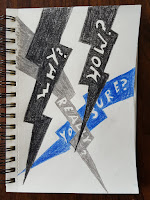
Dear Friends,
If I can say one thing, it is that adding a daily discipline - other than the habits I'm used to - is hard! No surprise, there, but that's the short explanation of why I didn't do MWAH every day this month. Additionally, it's extra hard if it has you thinking about and confronting complicated and uncomfortable emotions... Motivation has been something I've struggled with, anyway. However, I'm glad I did even just the ones I did, since for me this is not just about my own healing and mental health, but is also a way that I can parent Charlie, too.
To wrap up the month, I'll recap the ones I did (essentially the first 7, give or take), with some notes about the inspirations and influences that inspired them. None of these are meant to represent finished pieces of art: they are, instead, pieces of thought, pieces of emotions, being processed visually and tactilely.
Yours,
Sarah
To subscribe, find the "subscribe by email" note in the left column and enter your email there. Posts will be emailed directly to you whenever I post them!
Resource list: Visit my spreadsheet at www.tinyurl.com/infantloss

Dear Friends,
If I can say one thing, it is that adding a daily discipline - other than the habits I'm used to - is hard! No surprise, there, but that's the short explanation of why I didn't do MWAH every day this month. Additionally, it's extra hard if it has you thinking about and confronting complicated and uncomfortable emotions... Motivation has been something I've struggled with, anyway. However, I'm glad I did even just the ones I did, since for me this is not just about my own healing and mental health, but is also a way that I can parent Charlie, too.
To wrap up the month, I'll recap the ones I did (essentially the first 7, give or take), with some notes about the inspirations and influences that inspired them. None of these are meant to represent finished pieces of art: they are, instead, pieces of thought, pieces of emotions, being processed visually and tactilely.
 |
| Prompt: Sunrise. This is probably one of the more obvious inspirations. You may notice that the question in the middle has been changed, slightly, to reflect my experience. |
 |
| Prompt: Beginnings. My inspiration here is biblical. "in the beginning God created..." "without form and void" "in the beginning was the Word" (this is primarily from Genesis and from the Gospel of John). Charlie's grave is on here, which is PART of God's creation, Charlie and Charlie's grave. |
|
| Prompt: Anxiety. To me, this can be what anxiety feels like. I was going to add more lightning, in reds and oranges, from the sides, with more questions and critiques, but ran short of time and energy that evening. |
 |
| Prompt: Grace. I was stumped on this one for a long time, because I find it hard to find positive things about Charlie's death, except for Charlie himself, and while granting myself grace/forgiveness is something I work on, it is harder to put into a visual form... But I do find that a piece of God's Grace came down when Charlie was baptized into the family of God, and I felt connection with the many other baptisms I have participated in or witnessed. |
 |
| Prompt: Mother. This prompt came up, apropos, on Mother's Day. I got frustrated at how much marketing is done at the "traditional" "normal" mother - one in a 2 parent household, with 2.5 children, all biological, conceived and born with no issues at all, of course. |
 |
| Prompt: Name. Probably obvious, this is my son's name! The tiger stripes are because he kicked a lot and we nicknamed him "our little Tigger", which stuck, and now tigers and tiger cubs, in general, represent him for us. Peacock is a family name. |
 |
| This is not from a prompt, but from a small Facebook support group I'm in. I offered to include names of the babies in the group in a drawing. Charlie is on here too, upper right. |
Yours,
Sarah
To subscribe, find the "subscribe by email" note in the left column and enter your email there. Posts will be emailed directly to you whenever I post them!
Resource list: Visit my spreadsheet at www.tinyurl.com/infantloss
Wednesday, May 16, 2018
Look at all the babies
(Topic: Grief vs. other people's pregnancies/babies)

Dear Friends,
Lately, I feel like every single person I know is having a baby - including about half my grief group members, local friends, Facebook friends, and even our favorite waitress at the diner we go to every week. This, itself, has been hard for me, but then - Princess Kate had her new little one too. Babies everywhere, and none for me.
I'm on a number of pregnancy and infant loss Facebook groups, and many of them pass around information, news articles, and blog posts that are relevant to current events. Mostly, it ends up being about people who have a loss or who advocate for those who do, but occasionally there are posts that end up specifically addressed to members of the loss community. When Princess Kate stood beautifully for the cameras holding a lace-wrapped princely bundle, a post came out addressed to moms - like me - for whom that image is painful. I'd like to share the link here, for those of you who are interested: https://www.mamamia.com.au/sad-about-royal-baby-news/
[I'm not including an image of the royal family here. It would be too hard for me to see]
The thing is, I'm not sad for the Princess - I'm happy for her. I'm happy her baby is healthy, and, more simply, alive. I'm happy that she has a new little one to cuddle and love and care for. But I'm so insanely jealous it hurts, and seeing her picture (and those of my friends on Facebook) makes the emptiness in my arms that much more tangible. I'm happy for my friends, I'm happy for the grief group members who are growing their own rainbow babies*, and I'm happy for my waitress, too. But I'm sad for myself, for my empty arms, and for my broken heart.
But the thing is, I also feel sorry for the Princess: I wish she had private time to recover, and to snuggle and enjoy. I wish that birth and death were more respected by the media, and given more private space. Plus, I can't help thinking about the terrible outcomes that didn't happen: What plans did the royal advisors have in place if something went wrong? Would the media have been told to back off? I hope so.These are the thoughts that occur to me, and I know that, because of similar thoughts, some who have further children after a loss decide to hold off on a baby shower or similar preparation, because we don't know that it will turn out ok. Others decide to make the most of the time they have, and do ALL the celebration - because they want good memories, even if things turn out badly. I don't know where I fall, yet, because I'm not going through it, yet. It seems to be very personal, which way people lean.
Another reason that it hurts so much to see the Princess, smiling, with her third little one in her arms; and the reason I sometimes unfollow friends on Facebook with small children; and the reason I cried at the diner; is that I'm hoping so hard, wishing so hard, to have another little one of my own. We want to give Charlie a little brother or sister, and we also want the experiences of being a diaper-changing mama and papa, because that is what we were hoping for with Charlie. With Charlie, we got turned into a memory-keeping mama and papa - which is a very important job - but that was not what we had been picturing. We'd like to reapply for the diaper job, please!
I'd like to try to describe what it feels like, sometimes, when I see a picture. I'm not sure I can completely capture it... When I see good news of someone's baby, a birth announcement, a carseat picture on the way home from the hospital, or just a cute wee one in mama's arms, the first thing I feel is a knot in my stomach. Over time I've learned that it is a knot of sad, which often only unravels with tears. I see the picture, and I see what I don't have, but twice: what I never got with Charlie, and what I don't yet have with a next child. The next thing I feel is hate, for the mother (not hating the mother herself, mind you). As that passes, I realize that it isn't hate, just really strong jealousy. And then I usually look away, scroll more, or change my activity, because it is too painful, sometimes, to be faced with what I don't have. Sometimes I cry.
There are many people dealing with loss, or infertility, or other related issues, who may not be able to view the joy of someone else's baby with the expected happiness. I only know it from my own perspective, that of a prior loss but with the possibility of a future child or children. I cling to hope. But sometimes it still hurts.
Yours,
Sarah
* Some terms to know that are commonly used in the pregnancy/infant loss community:
To subscribe, find the "subscribe by email" note in the left column and enter your email there. Posts will be emailed directly to you whenever I post them!
Resource list: Visit my spreadsheet at www.tinyurl.com/infantloss

Dear Friends,
Lately, I feel like every single person I know is having a baby - including about half my grief group members, local friends, Facebook friends, and even our favorite waitress at the diner we go to every week. This, itself, has been hard for me, but then - Princess Kate had her new little one too. Babies everywhere, and none for me.
I'm on a number of pregnancy and infant loss Facebook groups, and many of them pass around information, news articles, and blog posts that are relevant to current events. Mostly, it ends up being about people who have a loss or who advocate for those who do, but occasionally there are posts that end up specifically addressed to members of the loss community. When Princess Kate stood beautifully for the cameras holding a lace-wrapped princely bundle, a post came out addressed to moms - like me - for whom that image is painful. I'd like to share the link here, for those of you who are interested: https://www.mamamia.com.au/sad-about-royal-baby-news/
[I'm not including an image of the royal family here. It would be too hard for me to see]
The thing is, I'm not sad for the Princess - I'm happy for her. I'm happy her baby is healthy, and, more simply, alive. I'm happy that she has a new little one to cuddle and love and care for. But I'm so insanely jealous it hurts, and seeing her picture (and those of my friends on Facebook) makes the emptiness in my arms that much more tangible. I'm happy for my friends, I'm happy for the grief group members who are growing their own rainbow babies*, and I'm happy for my waitress, too. But I'm sad for myself, for my empty arms, and for my broken heart.
But the thing is, I also feel sorry for the Princess: I wish she had private time to recover, and to snuggle and enjoy. I wish that birth and death were more respected by the media, and given more private space. Plus, I can't help thinking about the terrible outcomes that didn't happen: What plans did the royal advisors have in place if something went wrong? Would the media have been told to back off? I hope so.These are the thoughts that occur to me, and I know that, because of similar thoughts, some who have further children after a loss decide to hold off on a baby shower or similar preparation, because we don't know that it will turn out ok. Others decide to make the most of the time they have, and do ALL the celebration - because they want good memories, even if things turn out badly. I don't know where I fall, yet, because I'm not going through it, yet. It seems to be very personal, which way people lean.
Another reason that it hurts so much to see the Princess, smiling, with her third little one in her arms; and the reason I sometimes unfollow friends on Facebook with small children; and the reason I cried at the diner; is that I'm hoping so hard, wishing so hard, to have another little one of my own. We want to give Charlie a little brother or sister, and we also want the experiences of being a diaper-changing mama and papa, because that is what we were hoping for with Charlie. With Charlie, we got turned into a memory-keeping mama and papa - which is a very important job - but that was not what we had been picturing. We'd like to reapply for the diaper job, please!
I'd like to try to describe what it feels like, sometimes, when I see a picture. I'm not sure I can completely capture it... When I see good news of someone's baby, a birth announcement, a carseat picture on the way home from the hospital, or just a cute wee one in mama's arms, the first thing I feel is a knot in my stomach. Over time I've learned that it is a knot of sad, which often only unravels with tears. I see the picture, and I see what I don't have, but twice: what I never got with Charlie, and what I don't yet have with a next child. The next thing I feel is hate, for the mother (not hating the mother herself, mind you). As that passes, I realize that it isn't hate, just really strong jealousy. And then I usually look away, scroll more, or change my activity, because it is too painful, sometimes, to be faced with what I don't have. Sometimes I cry.
There are many people dealing with loss, or infertility, or other related issues, who may not be able to view the joy of someone else's baby with the expected happiness. I only know it from my own perspective, that of a prior loss but with the possibility of a future child or children. I cling to hope. But sometimes it still hurts.
Yours,
Sarah
* Some terms to know that are commonly used in the pregnancy/infant loss community:
- Sunshine baby (a child before the loss)
- Angel baby (the loss - I have also seen "star baby" though I don't see it often)
- Rainbow baby (after the loss, which is the "rain", comes the rainbow - and you can't have a rainbow without first having rain)
To subscribe, find the "subscribe by email" note in the left column and enter your email there. Posts will be emailed directly to you whenever I post them!
Resource list: Visit my spreadsheet at www.tinyurl.com/infantloss
Wednesday, April 25, 2018
Birthday Ideas for Charlie
(topic: remembering a child on their birthday, infant loss, memorial ideas)

Dear friends,
This year, in June, Charlie will be turning 2. If you would like to help us remember him in a more tangible way, here are a few things you can do:
Yours,
Sarah
To subscribe, find the "subscribe by email" note in the left column and enter your email there. Posts will be emailed directly to you whenever I post them!
Resource list: Visit my spreadsheet at www.tinyurl.com/infantloss

Dear friends,
This year, in June, Charlie will be turning 2. If you would like to help us remember him in a more tangible way, here are a few things you can do:
Ways to remember Charlie on his 2nd Birthday (June 19th)
- Support the Now I Lay Me Down To Sleep photography association by pledging to our team (Team Tiger pledge page). We are participating in a fundraising walk the Saturday after his birthday, and the funds donated help support the organization so they can send pro-bono professional photographers to take pictures, for families experiencing infant loss
- Help Charlie's light shine! Some churches and religious organizations have permanently lit candles or lamps in their worship space. They often have sponsors, in memory of someone. I have reserved and sponsored the light at our current church and at the church I grew up in, for the week of June 17th. If you would like to sponsor one at your own place of worship, or just light a candle in Charlie's honor, that would be lovely.
- Borrowing an idea from another loss-mama's blog (Still Playing School), what about making Charlie's name in some way, and taking a picture? I'd love to see the results.
- And if none of these fit how you want to remember him, please understand that we don't want to force you to do anything! We just would love for our friends to happily remember Charlie with us. That's all it is. And if you decide to do so more tangibly, the above list items are just suggestions.
Yours,
Sarah
To subscribe, find the "subscribe by email" note in the left column and enter your email there. Posts will be emailed directly to you whenever I post them!
Resource list: Visit my spreadsheet at www.tinyurl.com/infantloss
Subscribe to:
Posts (Atom)


